The Backrooms

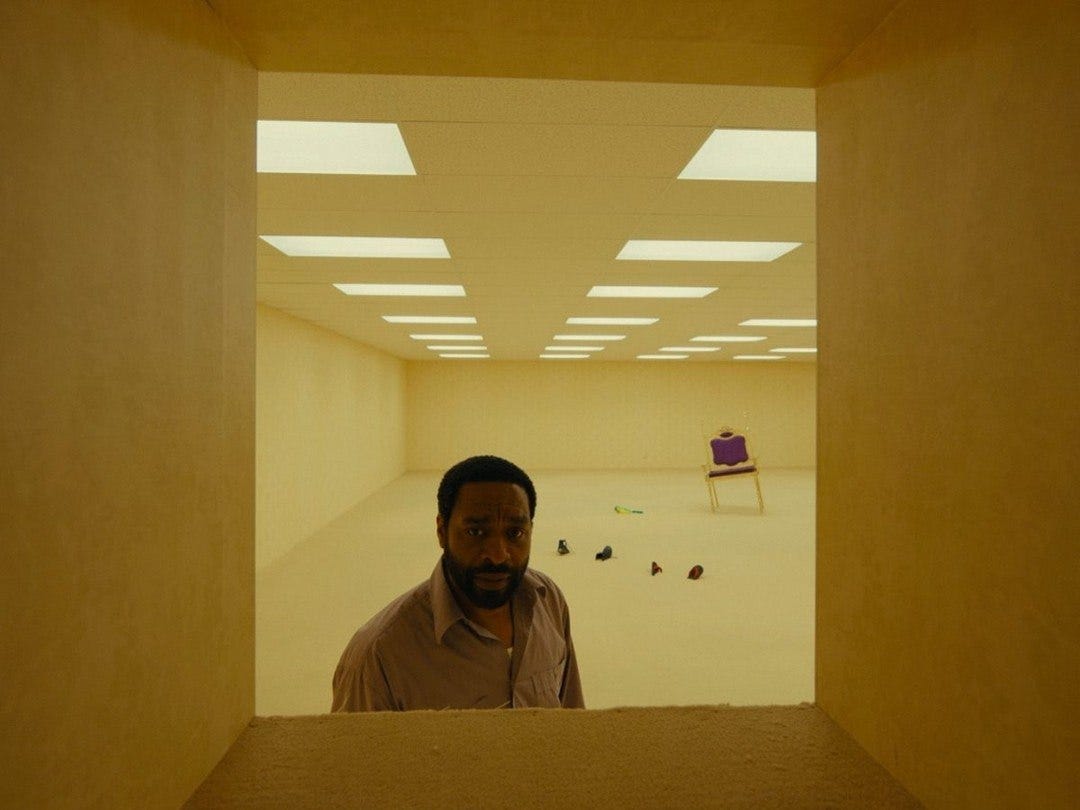
As a child I had several recurring nightmares, but the most mundane (and paradoxically, the scariest) was the haunted Christmas shop. There were rarely any customers in the store, but as an employee, albeit a dream employee without any discernable tasks or boss or co-workers, I existed under constant threat that a customer would appear.
The store contained a massive assortment of holiday bric-a-brac: a torrent of shiny baubles, green and red, silver and gold, ornaments and garlands, fake mistletoe and trees of every sort, Santa suits and hats and snowglobes and tiny gyrating Santas- all in a dimly lit basement with concrete walls. While I sat on the stool behind the dusty glass counter, dread mounted. I knew that something terrible was going to happen, that the door at the front of the store with its horde of jingle bells would burst open and an unspeakable evil would enter. But nothing ever did happen. The dream was the same every time: hours of desperation, boredom fighting with fear, attempts to wake myself up. It was an odd kind of hell. As I got older the dream ceased, to be replaced by other nightmares.
If you follow horror or film in general you’ve doubtless heard of The Backrooms, young director Kane Parson’s highly hyped feature debut based on his YouTube series. I have not seen Parson’s show, but as a horror- culture aficionado, I was familiar with the original creepypasta which inspired The Backrooms before I saw the film.
In 2019, on a paranormal themed 4chan message board asking for “disquieting” images, someone posted the following photo, from a furniture store that was under renovation, which inspired this description…
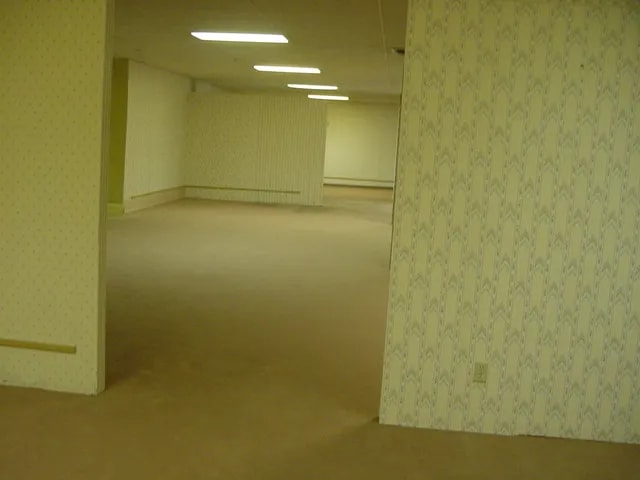
If you’re not careful and you noclip out of reality in the wrong areas, you’ll end up in the Backrooms, where it’s nothing but the stink of old moist carpet, the madness of mono-yellow, the endless background noise of fluorescent lights at maximum hum-buzz, and approximately six hundred million square miles of randomly segmented empty rooms to be trapped in
God save you if you hear something wandering around nearby, because it sure as hell has heard you
— Anonymous, 4chan (May 13, 2019)
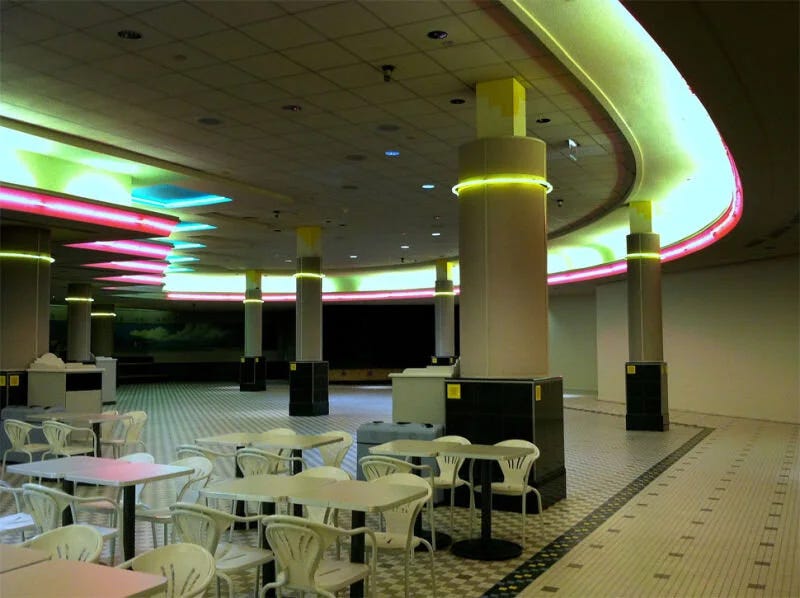
Liminal spaces are thresholds, places of transformation where anything can happen, from the magical to the terrifying. Doorways, corridors, waiting rooms, parking garages, alleys, airports, subways, highways, hotels, staircases. Abandoned places. The in-between. When I did a deep dive into a popular Reddit for Liminal Spaces, I found a surreal dreamscape: kudzu devouring a building, an inflatable church, many empty theaters, auditoriums, pools. The requisite dead malls, and other spaces of commerce made menacing by the absence of people. The Last Days of Burlington Coat Factory. Wood paneling. Windows screensavers. Many posters mention feelings of discomfort, the uncanny, nostalgia when engaging with these spaces. I see several pictures captioned with variations of the same theme: “I always end up back here”. Like the protagonist in The Backrooms, Clark (played by Chiwetel Ejiofor) who even before he is sucked into the alternate dimension from the basement of his failing furniture store, is going nowhere fast, stuck in a morass of addiction, debt, divorce and personal failure. As his therapist, Mary (Renate Reinsve) reflects,
“We all have our loops. Our habits. Behaviors that keep us walking in circles. Reaching for the same solutions over and over again. Thinking each time will take you somewhere new, but they don’t.”
In the 2020s, the Covid pandemic, the rise of fascism and both the existential and very physically real threats to the survival of many under hyper-capitalism have all have led to a greater appetite for horror, especially among young people. According to research published by firm Statista, 91 % of Gen Z and 87% of Millennial consumers worldwide watch horror movies or tv shows (compared to just 58% of Boomers).
Horror has always used liminal spaces as atmosphere to induce a sense of “off-ness” (for example the deserted Overlook hotel and its iconic hallway in the Shining, the abandoned spaces of found-footage and dystopian horror). The haunted house/castle, the archetype at the very foundation of horror and the gothic, often functions as a liminal space. But over the last decade(s) and the 2020s especially, use of corporate, capitalist liminal spaces in cinema, television, art and internet culture has exploded. (Many reviews have sighted the similarities between The Backrooms and the acclaimed television show Severance, but the film most reminded of escape rooms and other experiences, particularly Meow Wolf and its massive art installations. I definitely found myself wondering if Kane Parsons has ever been to Meow Wolf).
Spaces can swallow people, just as poverty swallows people. Seen through the funhouse mirror of hyper- capitalism, the haunted house, foundation of intergenerational trauma, becomes the Backrooms, an infinite dumping ground for the psychic trauma of existence in the modern age.
The Backrooms was the first film I’d seen in theaters since Hamnet, back in January (review). On the drive to Bozeman with my movie buddy JJ, we passed beneath a thick blanket of grey, wisps of cloud reaching down to touch the pines. The rain turned the infinite shades of green both brighter and darker. Unlike Hamnet, with its heavy green witch vibes, The Backrooms is a sterile corporate nightmare which blossoms into something far more surreal. Like the deserted Christmas shop, nary a customer is ever seen in Clark’s massive store. The few shots of “the outside” look unreal, painting-like, and the film quickly plunges the viewer into its alternate dimension, an unending labyrinth of random objects and debris, fluorescent lights and “mono-yellow” walls. After Clark (along with his one employee and her boyfriend) disappears, Mary comes to the store to look for him, and, of course, gets pulled into the Backrooms herself. There are things lurking in this endless labyrinth, and they chase the characters further and further into the maze.
The Backrooms was perfect for the immersion of the theater, a tonic for my green-addled mind, and I don’t think it would have been quite as effective on a small screen. After the film we were released into late afternoon post-rainstorm, squinting in the sunlight, smell of petrichor rising from the concrete. I love a surreal and hypnotic horror movie in the summer, an ideal escape from the season’s frenetic energy. I can’t remember a film in recent years that’s created quite as mesmerizing of a dreamscape.
Does The Backrooms live up to the hype? I agree with the general consensus that the characterization could have been stronger, that the plot’s a bit confusing but for me the strong acting from the leads and the excellent aesthetics and setting more than made up for those minor flaws.
JJ and I discussed the many dreams that the The Backrooms reminded us of the whole drive home. (Funnily enough, the film actually contains a creepy Christmas room, glimpsed during a chase scene, and there is a lot of Christmas content in the larger Backrooms canon. Look out for a future article creepy Christmas article later this year!)
The haunted Christmas shop in my childhood dreams was clearly based on my parent’s basement, which has one large “living space” including a TV/living room, a tiny kitchen and bathroom (left over from when it was a separate apartment), and weird back part with stained concrete floors and drains, a closet full of holiday décor, and my mother’s pottery wheel and kiln.
As written by Dr. Kelly Bulkeley for Psychology Today, “Carl Jung once dreamed of exploring a house with many different levels; as he descended from one floor to another, the décor changed from modern to ancient to Paleolithic. Jung interpreted his dream as a symbolic portrayal of the human psyche, with modern consciousness at the “top” of the structure, and the depths of the collective unconscious at the “bottom”. *
If the basement in dreams represents the subconscious, then the endless sub-basement of the Backrooms can be interpreted as a dumping ground for our collective unconscious in the internet age.
As David Kane of Doompunk Dispatch wrote of the film,
The Backrooms is a doomscroll. There is no correct way to engage with it. There is no bottom to scratch. The itch never stops. You just drown in the sense of numbness you seek from seeing something different, something new.
The Backrooms itself is something different, something new, a film that provides an apt metaphor for the existential distress that technology foists upon us in the age of the hyperreal.
/MAKE AN OFFERING/ 💀 your tips help support my writing!
Sources:
Thanks 🖤 glad you enjoyed the review! I've been having a good time diving into the whole liminal aesthetic/obsession...I agree that the soundtrack helped heighten the dreamscape/nightmare feel. I love a good immersive horror in the summer ☀️ well anytime but especially in the summer
Super dope overview of the film with some appreciated insight. I loved the film personally and one thing that really stood out to me was the audio and soundtrack that elevated the atmosphere into that dream-like state. The vision was so well executed and fun to see put to the big screen. Also the "captain" so to speak actually scared the shit out of me. Hadn't felt that in a while.